

Foundations
Part of What do micro influencer marketing foundations involve for a buyer?
How do you read micro influencer marketing demand signals?
A buyer's guide to reading micro influencer marketing demand signals, with inclusion criteria, a comparison table and UK sources for market sizing work.
What to take away
- Rank demand signals by verification cost. Search volume, job adverts and dated rule changes are cheap and independent of platform numbers; rate cards and pitch decks are not.
- Build the case on at least three signals that point the same way, then stress-test it at half the assumed demand.
- Take market sizing from ONS digital economy statistics and quote the release date rather than an agency estimate.
- Refresh quarterly, and bring the review forward when a named rule or a platform term changes.
How to rank demand signals
Trust the signals you can check yourself, date and cite without anyone's permission. Search volume, job adverts and published rule changes pass that test. Platform dashboards and agency decks usually fail it.
Apply this sequence:
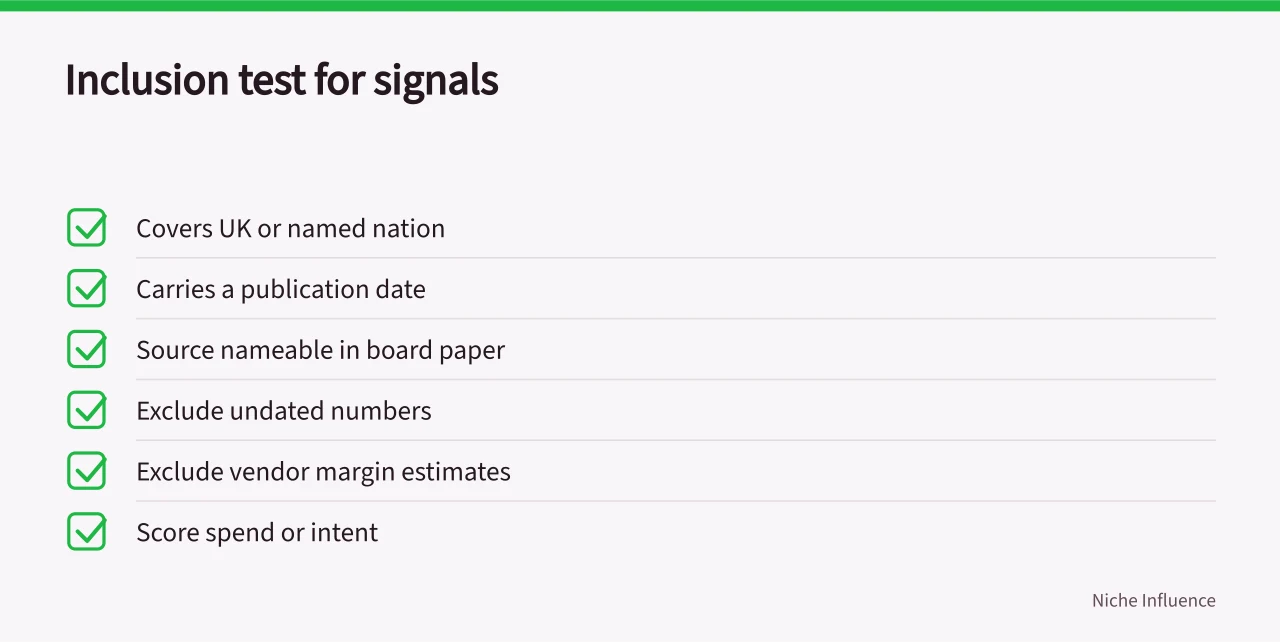
- Write an inclusion test. A signal qualifies if it names the UK or a single nation, carries a publication date, and comes from a body you can name in a board paper.
- Score it on verification cost. Search and hiring data are free to check; platform analytics need account access.
- Decide whether it measures spend or intent. Intent data moves first and needs a second source.
- Re-score your top three signals each quarter.
If you are drafting the brief for the first time, the explanation of micro influencer marketing foundations for a buyer fixes the definitions that keep a budget paper consistent with the campaign wording.
Which signals to check, and what they cost
| Signal | What it tells you | Cost to verify | Main weakness |
|---|---|---|---|
| Search volume | Buyer interest over time | Low, free tools | Research blurs into purchase |
| Job adverts | Budgets being formalised | Low, public listings | Lags spending by months |
| Platform creator tool launches | Supply-side investment | Low, public announcement | Announcement is not adoption |
| Update to the ASA affiliate marketing advice page | Buyers must re-brief creators | Low, dated page | Only covers the practices it addresses |
| GOV.UK self-employment guidance | Contracting friction | Medium | Depends how the creator trades |
| Agency pitch decks | Direction of travel | High | Vendor incentives distort |
Search and hiring rank highest
Search volume
- What it shows
- Buyer interest
- Cost to verify
- Low
- Observable
- Yes
- Dated
- Yes
- Independent
- Yes
Job adverts
- What it shows
- Budgets formalising
- Cost to verify
- Low
- Observable
- Yes
- Dated
- Yes
- Independent
- Yes
Where a creator trades as a sole trader rather than through a limited company, the GOV.UK guidance on working, jobs and pensions sets out the framework that applies and changes the paperwork on both sides.
The IAB UK account of its own role explains which body sets the standards most UK digital advertisers follow, which helps you weigh a platform's claim.
Dated legislation gives you a free anchor. The Digital Economy Act 2017 received Royal Assent on 27 April 2017, and it is a marker you can cite when a brief touches online advertising rules.
Where to find UK search-volume and job-advert data
Google Trends is free and gives relative interest with a regional split for England, though it shows direction rather than volume. Google Keyword Planner gives banded volumes and needs a Google Ads account. Paid suites such as Ahrefs and SEMrush add competitor gap data.
For hiring, check the ONS vacancy releases, DWP Find a job, LinkedIn Jobs, Indeed and Adzuna. Advert counts for creator roles show budgets moving from testing to committed.
The ONS digital economy statistics publish dated estimates of digital activity, so a budget paper can cite the reference period instead of an undated claim.
Example: three signals into one budget line
Say a team pays £400 a month per niche creator across ten creators. That is £48,000 a year, an illustrative figure used only to show the arithmetic.
Now test the same case at half the assumed demand. If the campaign still returns £48,000 from roughly half the reach, the signal set is strong enough to fund.
A budget case is only as strong as its weakest signal. When a rule change and a hiring trend agree but search interest is flat, fund a pilot rather than a year.
Demand signals show whether the market is moving, not who carries the risk when it stops. The comparison of micro influencer marketing business models explains how retainers and performance fees behave in a softer quarter.
How often to refresh
Quarterly suits search and hiring trends, because both move slowly enough to survive one reporting cycle. A monthly review adds noise without changing the ranking.
Bring the review forward when a named rule changes or a platform alters its creator terms. Keep a dated watch list so the next budget paper can show what moved and when.
Common questions
Which demand signal is most reliable?
Search volume and job adverts, because both are dated and verifiable without platform access. Pair them with a published rule change before you commit budget.
Does UK-wide data apply to England?
Not always. Some public services are administered separately in Scotland, Wales and Northern Ireland, so note the nation you are buying for.
How do I size the UK market without an agency estimate?
Use the ONS digital economy releases and cite the reference period. If the gap is still too wide to defend, the guidance on micro influencer marketing benchmark research explains when commissioning your own figures is worth the fee.
Do I need to check a creator's employment status?
Yes. Confirm whether they trade as a sole trader or through a limited company before terms are agreed, because the answer changes tax and contract risk on both sides.