

Rules and ethics
Cross-border micro-influencer briefs for the UK and Ireland after Brexit
Micro influencer marketing across the UK and Ireland needs dual disclosure, correct VAT treatment and audience overlap checks. Here is how to brief both markets.
What to take away
- A single brief covering the UK and Ireland must satisfy two advertising codes: the ASA's CAP Code and Irish advertising rules, so disclosure wording and monitoring differ by market.
- Cross-border micro influencer marketing also splits on VATUK VAT applies to UK-based creators, Irish VAT to Irish creators, and place of supply rules decide who charges what.
- Audience overlap between UK and Irish followers is common, which distorts reach and attribution if you report on combined numbers.
- Post-Brexit, the UK sits outside the EU's VAT and data regimes, so contracts, currency and data transfers need explicit cross-border clauses.
- Use a dual-jurisdiction checklist and separate disclosure instructions for each market rather than one generic line.
Why one brief across the UK and Ireland creates two compliance regimes
Micro influencer marketing across the UK and Ireland looks like one campaign. Legally it is two. A brief that says "disclose clearly" works in neither market. Both countries share a language and much audience behaviour, but they do not share a regulator.
The Advertising Standards Authority (ASA) administers the CAP Code in the UK, and its rules on recognising ads apply to social media and influencer marketing. In Ireland, the Advertising Standards Authority for Ireland (ASAI) administers the Code of Standards for Advertising and Marketing Communications in Ireland. The ASAI is a self-regulatory body; the Competition and Consumer Protection Commission (CCPC) is Ireland's statutory consumer protection authority. A UK brief cannot simply be copied across.
This matters because micro-influencers often work alone, without an agent or legal team. They follow the brief. If the brief is ambiguous about which code applies, the creator will default to whatever they did last time. That may be fine for one market and a breach in the other.
The Competition and Markets Authority (CMA) also polices hidden ads in the UK. Its CMA guidance for content creators makes clear that payment or any other incentive must be disclosed.
A UK brief that omits this is already weak. A cross-border brief that omits it is weaker still, because the Irish creator may not know the CMA exists.
Post-Brexit trading position adds a layer. The UK is no longer inside the EU's single market and customs union. For services such as influencer marketing, that changes tax and data rules rather than banning trade. The old assumption of one EU-wide approach no longer holds.
So the first job is to accept two regimes. One brief can still work, but it must contain two clear sections: UK disclosure and Irish disclosure. Deliverables and deadlines can stay common.
If you brief only in one market today, start with how to brief micro influencer marketing under UK regulations and add the Irish layer on top.
Dual-jurisdiction disclosure: ASA, CAP Code and ASAI Code
Dual-jurisdiction disclosure means the same post may need to meet two standards at once. A micro-influencer based in Dublin with followers in Dublin and Manchester can fall under both the Irish rules and the UK CAP Code. Meet the stricter standard in both markets, not the average.
UK vs Ireland disclosure rules
UK (ASA/CAP)
- Regulator
- ASA
- Label
- Ad or Advertisement
- Placement
- First two lines
- Platform tag
- Paid partnership
- Extra rule
- CMA: gifts count
Ireland
- Regulator
- Irish body
- Label
- Clear identification
- Placement
- First two lines
- Platform tag
- Paid partnership
- Extra rule
- Irish guidance
The ASA guidance on recognising ads is the practical starting point for UK-facing content. It explains that ads must be obviously identifiable, and that labels such as "Ad" or "Advertisement" work better than vague tags. One hashtag lost amongst twenty others will not do.
On the Irish side, the ASAI's Code of Standards for Advertising and Marketing Communications in Ireland requires marketing communications to be clearly identifiable. The ASAI handles complaints under that self-regulatory code; the CCPC is the statutory consumer protection authority. Wording that satisfies one code may not satisfy the other.
A useful rule is a plain label in the first two lines of the caption, plus a platform-level paid partnership tag where available. That covers both regimes without over-labelling.
The CMA also matters for any creator whose content can be seen in the UK. Endorsements must be transparent, and that includes gifts, free products, trips, affiliate links and revenue shares, not just cash.
One common failure is the thank you post. A creator receives a product, posts a thank you, and tags the brand. In the UK that can count as an ad if the brand controlled the content or the creator was incentivised. Ireland applies the same logic. The brief should say that any incentive triggers disclosure, with examples.
Another failure is the platform tag alone. A paid partnership label helps, but it does not replace a clear disclosure in the caption. Some platforms hide the label behind a tap. Require both, and give creators a model caption for each market: for example, UK-facing copy could start "Ad – paid partnership with [Brand]" and Irish-facing copy "Advertisement – paid partnership with [Brand]". Keep the label prominent and check the final wording against the relevant code.
The UK consumer protection regime changed under the Digital Markets, Competition and Consumers Act 2024, which gives the CMA stronger tools against unfair commercial practices, including misleading endorsements. In Ireland, the CCPC enforces consumer protection law, including the Consumer Protection Act 2007. That raises the importance of getting disclosure right in both markets.
For a dual-market brief, name the ASA and CAP Code for UK-facing content, and the ASAI and its Code of Standards for Advertising and Marketing Communications in Ireland for Irish-facing content. Give each creator a market-specific model caption. The CMA enforces UK consumer protection law, while the CCPC is Ireland's statutory consumer protection authority; do not leave the creator to guess which rules apply.
What the two regimes require in practice
For the Irish column, name the ASAI and its Code of Standards for Advertising and Marketing Communications in Ireland. The ASAI is the advertising self-regulatory body; the CCPC is the statutory consumer protection authority. These roles are not interchangeable.
UK
- Main regulator or code
- ASA and CAP Code
- Key disclosure trigger
- Payment or any incentive, including gifts and affiliate links
- Preferred label
- "Ad" or "Advertisement", clear and upfront
- Platform tools
- Paid partnership tag plus caption label
- Enforcement risk
- ASA ruling and reputational damage
- Extra layer
- CMA hidden ads guidance
Ireland
- Main regulator or code
- Irish advertising rules and standards body
- Key disclosure trigger
- Marketing communication, including gifted and paid content
- Preferred label
- Clear identification, upfront and unambiguous
- Platform tools
- Paid partnership tag plus caption label
- Enforcement risk
- Irish standards process and reputational damage
- Extra layer
- Irish consumer law and advertising codes
A model disclosure block for a dual-market brief
- Put "Ad" or "Advertisement" at the start of the caption, before any hashtags.
- Add the platform's paid partnership tag where the platform supports it.
- Keep the disclosure visible without tapping "more".
- Repeat the disclosure in any Stories frame that features the brand.
- Do not rely on a single hashtag at the end of a long caption.
- If the post targets both markets, use the wording that meets both standards.
VAT treatment for cross-border micro influencer marketing payments
VAT treatment is where cross-border campaigns most often go wrong. The basic question is: who is supplying what, to whom, and where? For ordinary business-to-business advertising services, the place of supply is generally where the business customer belongs; the customer may have to account for VAT under the reverse charge. For business-to-consumer services, the general place-of-supply rule is different. Check the facts and any exceptions before deciding what the invoice should show.
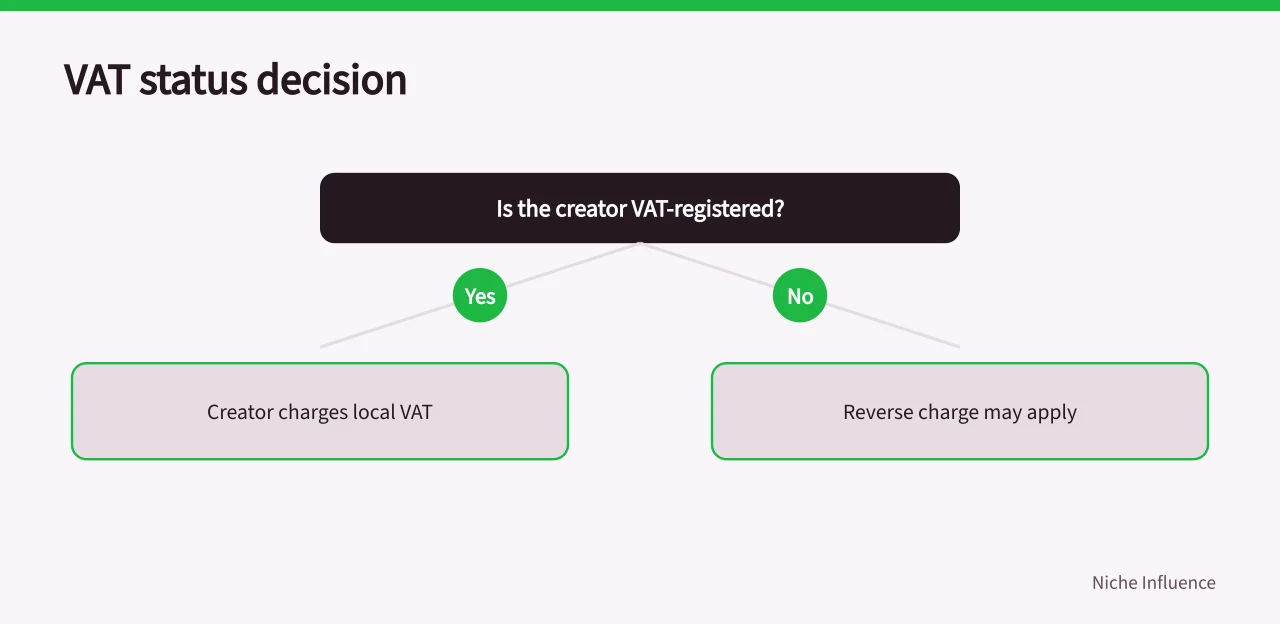
For UK-based creators, HMRC treats most influencer income as taxable trading income once it exceeds the trading allowance. If the creator is VAT-registered, they charge UK VAT on their invoices. If they are not registered, they do not charge VAT, but the income is still taxable. A brand cannot assume that a small creator is outside the tax system.
For Irish-based creators, Irish VAT rules apply. If they are registered for VAT in Ireland, they charge Irish VAT at the applicable rate. If they are not registered, the reverse charge may shift the VAT obligation to the UK business for certain B2B services. That is a question for an accountant, but the brief should flag it.
Post-Brexit, the UK is a third country for EU VAT purposes, while Ireland remains in the EU VAT system. That affects reporting and the way cross-border supplies are handled, but it does not mean every Irish creator charges Irish VAT to a UK business: the place-of-supply and reverse-charge rules still need to be checked. Make the customer, creator location, VAT numbers and agreed treatment explicit.
The practical answer is to agree the VAT position before the contract is signed. Ask each creator for their VAT number, or a written statement that they are not registered, and confirm whether the customer or supplier must account for VAT. Put the answer in the contract. Invoices should show the applicable VAT amount and number when VAT is charged; where the reverse charge applies, make that treatment clear. If the creator is not VAT-registered, record that too.
Currency matters too. Paying in euros from a UK account can trigger conversion fees and timing differences. Agree whether the invoice is in sterling or euro, and which exchange rate applies on the payment date. A simple clause prevents a dispute later.
For agencies, the risk is double counting. If you pay an Irish creator gross and cannot reclaim the VAT, your campaign cost rises. Build that into the budget before you brief. A small pilot with three creators will reveal the real cost quickly.
VAT scenarios at a glance
| Creator location | VAT registered? | Likely invoice treatment |
|---|---|---|
| UK | Yes | Charges UK VAT at the applicable rate |
| UK | No | No VAT charged, income still taxable |
| Ireland | Yes | Charges Irish VAT at the applicable rate |
| Ireland | No | No VAT charged, reverse charge may apply to UK business |
Audience overlap problems when creators reach both markets
Audience overlap is the quiet problem in cross-border micro influencer marketing. A creator based in Belfast may have followers in both Northern Ireland and the Republic of Ireland. A creator in Liverpool may have a large Irish diaspora following. If you brief ten creators across the two markets, some of their audiences will be the same people.
Overlap distorts measurement. Combined reach looks impressive until you deduplicate. If three creators reach the same 20,000 people, your true unique reach is smaller than the sum. Engagement rates can also look inflated if the same core fans interact with every post.
Overlap also affects disclosure. A creator with a mixed audience may need to satisfy both the UK and Irish regimes in a single post. That is not a reason to avoid them. It is a reason to brief them properly and to check their audience geography before you agree the fee.
Ask for audience location data from the platform insights. Look at the top five countries or regions. If the UK and Ireland both appear, treat the creator as dual-jurisdiction. If one market dominates, you can use the relevant disclosure as the primary label and add a secondary line for the other.
For reporting, separate the markets. A single combined dashboard hides the overlap. Build two views: one for UK-attributed performance and one for Irish-attributed performance. Where a creator reaches both, attribute by audience share rather than by creator location.
Finally, avoid briefing the same creator twice for the same campaign in both markets. That is a fast route to duplicate content and audience fatigue. If you need both markets covered, use different creators with different angles, and coordinate the posting schedule.
Contracting, currency and payment terms across the border
A cross-border contract needs more than a scope of work. It needs to say which law governs, where disputes are heard, how VAT is handled, and what happens if a post is removed. For micro-influencers, keep it short but explicit.
Start with the parties. Use the creator's legal name and trading name, plus their address and VAT status. If they trade through a limited company, check it on Companies House for a UK company or the Companies Registration Office (CRO) for an Irish company. This prevents payment to the wrong entity.
Next, the deliverables. State the platform, the format, the number of posts, the deadlines and the disclosure wording. Attach the model caption for each market. If the creator is dual-jurisdiction, attach both.
Then the money. State the fee, the currency, the payment date and the method. If VAT applies, say who charges it. If the creator is not VAT-registered, say that too. Add a clause for currency conversion if the invoice is in a different currency from the payment.
Usage rights matter. A UK brand may want to reuse the content in paid ads. That needs a licence, a duration and a territory. If the content will run in both the UK and Ireland, the licence should cover both. The Intellectual Property Office publishes guidance on copyright and licensing if you need the basics.
Termination and removal are the clauses creators care about. If a platform removes the post, or the creator deletes it, what happens to the fee? A fair contract pays for work done and requires a correction post where possible. Avoid clawback clauses that punish the creator for a platform decision.
Data protection belongs here too. The UK GDPR applies to UK processing, and the EU GDPR applies to processing within its scope in Ireland. The ICO is the UK regulator and the Data Protection Commission (DPC) is Ireland's regulator. UK-to-Ireland transfers are permitted under the UK's adequacy regulations for the EEA; Ireland-to-UK transfers are covered by the EU's adequacy decision for the UK. You do not normally need an International Data Transfer Agreement just for a transfer between the UK and Ireland. For transfers to other destinations, check whether an adequacy arrangement applies or whether safeguards such as the UK International Data Transfer Agreement or UK Addendum are needed. The brief should say what data you need and why.
If you are drafting commercial contracts without the renegotiation trap, build the cross-border clauses in from the start. Adding them after the campaign starts is expensive and slow.
A worked example: one campaign, two markets
A Manchester skincare brand wants ten micro-influencers: five in the UK, five in Ireland. The budget is £12,000 plus VAT where applicable. The goal is 500,000 combined reach.
The brief includes two disclosure blocks. UK creators use a prominent "Ad" or "Advertisement" label, with the paid partnership tag where available. Irish creators use a prominent "Advertisement" label, with the tag where available. Both captions are checked against the relevant code. Two creators have mixed audiences, so their instructions cover both markets.
VAT is agreed before signing. Three UK creators are VAT-registered and charge UK VAT. Two are not. Two Irish creators are VAT-registered and charge Irish VAT. Three are not, and the reverse charge is noted in the contract.
Payment is in sterling for UK creators and euro for Irish creators. The exchange rate is fixed on the invoice date. The contract states that removal by the platform does not trigger clawback if the post ran for at least 48 hours.
Reporting separates UK and Irish performance. The team deduplicates reach using platform data and reports unique reach, not summed reach. The campaign lands at 430,000 unique reach, which is below the headline target but honest.
A cross-border brief checklist for UK and Ireland campaigns
Use this checklist before you send a brief that covers both markets. It is designed for micro-influencer campaigns where the creator may not have legal support.
Cross-border brief checklist
- Confirm creator location and audience geography
- Attach UK and Ireland disclosure wording
- State that gifts and trips trigger disclosure
- Ask for VAT status and VAT number
- Agree invoice currency and exchange rate rule
- Include usage licence for both markets
- Plan separate UK and Irish reporting
- Confirm the creator's location and audience geography, including any dual-jurisdiction following.
- Attach the correct disclosure wording for the UK and for Ireland, with a model caption for each; name the CAP Code and the ASAI Code of Standards for Advertising and Marketing Communications in Ireland.
- State that any incentive, including gifts, trips and affiliate links, triggers disclosure.
- Ask for VAT status and VAT number, or a written statement that the creator is not registered; record the place-of-supply and reverse-charge treatment.
- Agree the invoice currency and the exchange rate rule before work starts.
- Include a usage licence covering both the UK and Ireland if you plan to reuse content.
- Add a data protection clause that reflects the UK GDPR or EU GDPR as applicable, and check international transfers with the ICO or DPC if data goes beyond the UK-Ireland adequacy arrangements.
- Set out what happens if a post is removed or deleted, including whether the fee is still payable.
- Check the creator's company details on Companies House for a UK company or the Companies Registration Office for an Irish company.
- Plan separate UK and Irish reporting, and deduplicate reach where audiences overlap.
If you are building a market entry checklist for micro influencer marketing, treat this as the cross-border annex. The core checklist covers platform choice, creator vetting and measurement. This one covers the two-regime problem.
It also helps to check rules and ethics before you brief. A creator who has previously posted undeclared ads is a risk in both markets. A quick review of their last ten posts will show whether they label consistently.
Finally, keep the brief short enough to be read. A twenty-page document will not be followed. Two pages of clear instructions, with the model captions and the VAT questions, will be.